Most enterprise AI systems today share a fatal flaw: they are incredibly articulate guessers. We have spent the last few years marveling at AI's ability to generate text, confusing linguistic fluency with cognitive reasoning. But when a localized port strike threatens to choke a global supply chain, predicting the next word is useless. You don't need a chatbot; you need a system that can perceive an anomaly, trace its blast radius across a causal graph, stress-test alternative paths, and execute an optimal pivot.
The transition from Generative AI to true Agentic AI will not happen through better prompting. It requires a fundamentally new architecture of machine thought. To build autonomous agents capable of navigating high-stakes, volatile enterprise environments, we must move beyond linear pipelines and flat prompt-response loops. We must build systems capable of deep internal reflection, causal analysis, and continuous learning.
We must build systems that can recurse.
Welcome to the R.E.C.U.R.S.E. Framework
The R.E.C.U.R.S.E. Framework is an architectural blueprint for a closed-loop Cognitive Operating System. It organizes machine intelligence into four distinct, interdependent layers:
- Perception: Separating signal from noise (Recognize & Examine)
- Reasoning: Moving from correlation to causation (Correlate & Understand)
- Action: Stress-testing solutions before execution (Refine & Synthesize)
- Memory: The continuous evolution loop (Evolve)
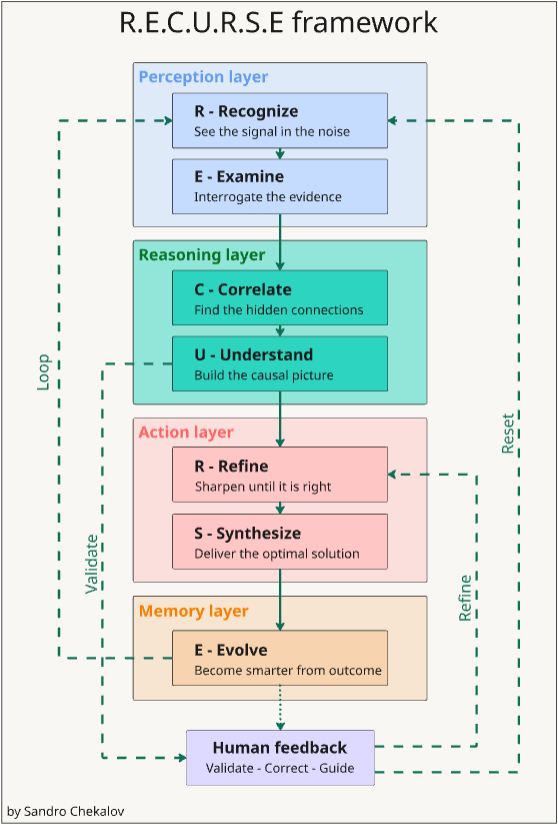
By transforming data through this structured cognitive stack, we move away from brittle "black-box" models and toward predictable, enterprise-grade AI autonomy. Let’s explore how this architecture functions under the pressure of a real-world enterprise crisis: a cascading global logistics disruption.
Layer 1 The Perception Layer
The Perception Layer serves as the system's sensory boundary. Before an autonomous agent can act, it must accurately perceive reality, filter critical signals from background static, and build a verified baseline of facts.
R — Recognize: See the Signal in the Noise
The system opens its eyes. Raw information floods in from disparate sources: databases, event streams, documents, IoT sensor feeds, user conversations, and system logs. Instead of mere data ingestion, the platform applies contextual filters and anomaly detectors to distinguish a meaningful signal from ambient enterprise noise.
Crucially, Recognize establishes temporal context: is this signal a novel anomaly, a recurring pattern, an escalating threat, or a fading blip? At this stage the system produces no answer and takes no action. It raises a contextualized alert that a specific anomaly warrants closer inspection.
Hypothetical scenario: Rather than waiting for a delayed shipment notification, the system's Recognize layer ingests a localized severe weather alert in the South China Sea, a minor union strike notice at a European transit port, and a subtle 2% uptick in Tier-2 supplier lead times. While standard dashboards view these as isolated, routine events, the system recognizes a compounding temporal pattern: a major bottleneck is forming.
E — Examine: Interrogate the Evidence
Where Recognize identifies that something is happening, Examine demands to know exactly what it is. The system applies deep analytical scrutiny to the flagged signal: disaggregating the data into its core components, testing immediate hypotheses, and aggressively challenging surface interpretations.
An agentic architecture must ask adversarial questions of its own findings: Is this metric accurate, or is it a data artifact? Is this trend skewed by the observation window? By cross-referencing multi-modal sources, the system constructs a structured evidence package categorized into epistemic tiers. It explicitly defines what is known with absolute confidence, what remains uncertain, and what is currently unknown.
Hypothetical scenario: The system automatically initializes a diagnostic sub-agent to interrogate the bottleneck signal. It queries the live GPS coordinates of in-transit cargo ships, pulls real-time inventory levels across regional warehouses, and audits alternative supplier capacities. It filters out speculative news reports and compiles a hard data package: a confirmed critical component shortfall of 40,000 units will hit the primary assembly plant in exactly 21 days.
Layer 2 The Reasoning Layer
Perception gathers the pieces; Reasoning solves the puzzle. In a standard data pipeline, identifying an anomaly triggers an immediate, pre-programmed alert or a brittle automated response. The R.E.C.U.R.S.E. framework rejects this reflex. Before any action is taken, the system must transition from observing what is happening to understanding why it is happening and how it connects to the broader enterprise ecosystem.
This layer transforms isolated evidence into a dynamic, causal model of the operating environment.
C — Correlate: Find the Hidden Connections
The system moves from observation to an understanding of relationships. No data point exists in a vacuum. The platform maps how signals, entities, events, and variables interact across time, space, and business units, building a comprehensive, multi-dimensional graph.
Standard analytics finds correlations; R.E.C.U.R.S.E. demands causation. The system traces impact chains that span multiple systems and time horizons. It actively searches for circular dependencies and maps out exactly where a localized failure might produce catastrophic, unintended consequences in a completely different sector of the business.
Hypothetical scenario: The agent maps the blast radius of the perceived data. It correlates the 40,000-unit component shortfall directly to the upcoming Q3 product launch in Europe. But it goes deeper, tracing a hidden dependency: standard protocol would dictate an immediate pivot to Backup Supplier B. However, the system's causal graph reveals that Supplier B shares the exact same regional freight carrier currently entangled in the port strike. A blind pivot would not solve the delay; it would simply bottleneck the packaging supplier as well.
U — Understand: Build the Causal Picture
This is the deepest cognitive stage of the framework. The system does not immediately jump to a single conclusion. Instead, it holds multiple competing hypotheses simultaneously, weighs them against the established evidence package, and constructs a ranked set of root-cause explanations.
The system operates not just with data, but with degrees of certainty, attaching explicit confidence levels to each hypothesis. The output is a Situation Model: a narrative-structured, logical explanation that a human expert can read, critique, and validate. This is where Human-in-the-Loop (HITL) oversight is most critical, ensuring strategic alignment before the system shifts into autonomous solution generation.
Hypothetical scenario: The system builds the situation model and presents it to the Supply Chain Director. It does not simply flash a red "Delayed" warning. Instead, it presents a clear causal hierarchy: "Hypothesis 1 (88% Confidence): The root cause of the Q3 launch risk is the port strike, compounded by Supplier B's shared freight vulnerability. Immediate pivot to Supplier B is mathematically invalid." The human expert reviews this unpacked logic and validates the assessment, authorizing the system to begin engineering a workaround.
Layer 3 The Action Layer
Understanding a crisis is only half the mandate; solving it is the other. The Action Layer crosses the threshold from cognitive diagnosis to active engineering. In legacy automation, this transition is a fragile hand-off: an alert triggers a static, predefined playbook. If the playbook fails or triggers secondary errors in a dynamic environment, the legacy system is blind to the fallout.
The R.E.C.U.R.S.E. framework introduces an aggressive, iterative validation stage before a single byte of execution data leaves the platform. Rather than spit out the first available answer, it constructs, attacks, and tailor-fits a multi-dimensional solution space.
R — Refine: Sharpen Until it is Right
This is the iterative intelligence engine, the stage that most decisively separates R.E.C.U.R.S.E. from linear pipelines. Before committing to a solution, the system subjects its own candidate strategies to rigorous, automated self-critique.
The agent operates in a digital sandbox. It generates multiple competing pathways and stress-tests them against strict operational constraints: feasibility, budget, risk tolerance, and critical second-order effects. It calculates these trade-offs mathematically, seeking to maximize utility without breaching hard boundary conditions.
The output is a ranked Solution Portfolio that displays explicit trade-offs, fully exposed assumptions, and the mathematical "why" behind every option.
Hypothetical scenario: Armed with the knowledge that Backup Supplier B is a logistical dead end, the system's Refine layer simulates alternative realities.
Option 1: Air-freight components from Supplier C (Solves the 21-day timeline, but obliterates the product's profit margin by 34%).
Option 2: Split-route the allocation — redirecting critical 15,000 units via rail through an alternative corridor and delaying the European launch by an acceptable 4 days. The system optimizes Option 2, proving it protects 92% of the margin while staying within predefined enterprise risk thresholds.
S — Synthesize: Deliver the Optimal Solution
The final step of the Action Layer is execution, but execution demands translation. Synthesize transforms the raw optimization data from the Refine stage into a highly coordinated, multi-audience action package.
An autonomous agent cannot deliver raw JSON to a human board member, nor can it deliver a prose paragraph to a downstream ERP system. Synthesize shapes the optimal solution for the specific consumer. For human operators, it packages the strategy with clear ROI, confidence metrics, and structured timelines. For machine nodes, it compiles structured payloads ready for immediate execution. Crucially, this package is never brittle. It includes automated contingency triggers that define exactly what the system will do if the primary recommendation meets real-world resistance.
Hypothetical scenario: The system deploys its finalized strategy across three distinct vectors. For the Chief Logistics Officer, it synthesizes an executive brief outlining the margin protection and the 4-day timeline adjustment. For the procurement desk, it generates pre-filled, compliance-checked purchase orders for Supplier C. For the warehouse management API, it transmits automated routing manifests to clear receiving capacity for the incoming rail freight on Day 18.
Layer 4 The Memory Layer
The fatal vulnerability of standard agentic systems is cognitive amnesia. They treat every problem as Day One. An LLM agent can solve a complex task today, but tomorrow it will approach the exact same issue with the same blind spots, requiring the same prompts, the same API calls, and making the same expensive mistakes.
The R.E.C.U.R.S.E. framework solves this by closing the loop. The Memory Layer is the operational heartbeat of the system. It is the mechanism that transitions the platform from an automation tool into an appreciating corporate asset that scales in intelligence over time.
E — Evolve: Become Smarter from the Outcome
An autonomous system must learn from its own footprint. Once an action package is executed, the Evolve stage begins monitoring the real-world results of the intervention. It acts as a continuous optimization engine, comparing actual outcomes against the mathematical predictions made during the Refine stage.
To achieve true cognitive evolution, the system ingests three distinct streams of feedback:
- Outcome Data: The hard telemetry of what actually occurred post-execution.
- Human Feedback: Direct corrections, validations, and behavioral choices made by the human-in-the-loop during the Understand or Synthesize phases.
- Performance Metrics: A self-audit of how accurately each previous stage operated during the cycle.
By parsing these streams, the agent updates its internal Knowledge Graph and refines its algorithms. It builds an active, probabilistic "prior", ensuring that future Recognize phases catch anomalies earlier, Correlate stages find dependencies faster, and Refine stages bypass solution paths that have historically underperformed.
Hypothetical scenario: The system's split-route rail strategy is executed. However, real-world data reveals that the alternative rail corridor encountered a routine customs delay, causing the transit to take nine days instead of the modeled seven. The Evolve layer ingests this discrepancy. It does not just log an error; it dynamically updates the risk weights for that specific rail corridor within its long-term memory. The next time a port strike is Recognized, the system's Refine engine will automatically factor in a nine-day baseline for rail routing in that region, eliminating the optimization error before it can recur.
The Human Vector: Symbiosis Over Automation
A common anxiety in enterprise architecture is the "black-box" problem: the fear of giving autonomous agents the keys to execution without visibility. The R.E.C.U.R.S.E. framework addresses this by design. Rather than blind automation, it is built for cognitive symbiosis.
The framework treats human intelligence as a critical, high-fidelity data input rather than a bottleneck. By introducing structured gates at the Understand phase (verifying the causal situation model) and the Evolve phase (ingesting human correction), the architecture ensures complete alignment with corporate strategy, ethical boundaries, and shifting market realities.
The human guides the intent; the system optimizes the execution. Every time a human corrects the system, they do more than fix a temporary bug. They train the enterprise operating system to think like its best engineer, its sharpest logistics director, or its most risk-averse CFO.
Where to Start
The R.E.C.U.R.S.E. framework describes a mature system. It does not describe how to build one. The most common and most expensive mistake teams make is reading the four layers as a construction sequence and attempting to stand up perception, reasoning, autonomous action, and memory in a single program. A system assembled that way fails everywhere at once, and offers no way to diagnose which layer is at fault.
Begin instead with the shortest loop that still produces value.
Start with Perception and a human. The first system you deploy should Recognize and Examine. Then stop. Hand its structured evidence package to a human who performs the reasoning and owns the decision. This is its honest first form, not a compromised version of the framework. You are building the sensory boundary and proving it can separate signal from noise before you trust anything downstream of it. If perception is unreliable, no amount of reasoning or action will redeem the system, so it earns the right to be built first.
Instrument the feedback loop on day one, even though Evolve pays off last. The Memory layer is the slowest to mature and the easiest to defer, and deferring it is a quiet catastrophe. Evolve cannot learn from decisions you failed to capture. From the very first human judgment, record the input the system saw, the recommendation it made, and what the human actually did. You are not building the learning engine yet; you are preserving the data it will one day require. A system that captures this from the start becomes an appreciating asset. One that adds it in year two has already discarded its most valuable training signal.
Expand autonomy by confidence, not by calendar. Once perception is trusted, automate one stage at a time, and let each stage graduate on evidence rather than on a deadline. A stage moves from "propose and wait" to "act autonomously" only when its track record justifies the trust, governed by explicit confidence thresholds. The human gate is the scaffolding of the entire system: present at every stage at the outset, removed selectively and deliberately as each stage proves itself.
Built in this order, the architecture compounds. Each layer inherits a foundation that has already been validated, and each increment of autonomy is something the system has demonstrably earned. You are not deploying a finished brain. You are raising one, and teaching it, one trustworthy stage at a time, to recurse.
Conclusion: Building the Self-Improving Enterprise
We are standing at the precipice of the Agentic Era. The enterprises that win this next decade will not be those that simply deploy the most chatbots or string together the longest chains of static prompts. They will be the enterprises that build robust, resilient architectures capable of independent perception, causal reasoning, and continuous evolution.
The R.E.C.U.R.S.E. framework provides the blueprint for this transition. By organizing machine intelligence into a disciplined, four-layer cognitive stack, it moves AI from the realm of linguistic novelty into the domain of rigorous enterprise engineering.
When your architecture can Recognize the whisper of a problem, Examine its reality, Correlate its systemic ties, Understand its root cause, Refine its potential paths, Synthesize its execution, and Evolve from its outcomes, you no longer just have an AI tool.
You have a living corporate brain: an asset that becomes smarter, faster, and more valuable with every single problem it solves.